Macricostas School of Arts & Sciences
Western Connecticut State University
Zolberg Institute on Migration & Mobility
The New School
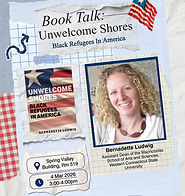
Unwelcome Shores:
Black Refugees in America


Unwelcome Shores: Black Refugees in America is a longitudinal ethnographic
study of the Liberian refugee community in Staten Island, NY—home to the largest per capita concentration of Liberians outside Liberia—that examines the racialization of Black refugees and the anti-Black racism they have experienced at every step of their migration journey. As one of the first books to explicitly investigate the role that race has played within the U.S. Refugee Admissions Program, Unwelcome Shores bridges (im)migration studies and scholarship on race in the United States, drawing attention to the ways refugee experiences are deeply shaped by racial hierarchies.
Focusing on Liberian refugees’ experiences, Unwelcome Shores shows that Black refugees and asylum seekers have faced additional burdens compared to non-Black forced migrants, including lower resettlement quotas and higher thresholds for proving persecution. These challenges persist after arrival, as Black refugees encounter both systemic and interpersonal forms of anti-Black racism that structure their reception and integration. In dominant narratives Black refugees’ humanity is often ignored in favor of overemphasizing presumed barbaric violence, endemic and everlasting wars, cultural backwardness, and diseases, subsequently rendering them less worthy of protection and resettlement.
The book explores how Liberian refugees respond to these exclusions. Many reject the “refugee” label, viewing it as a liability within a racialized context, and seek alliances with native-born Black Americans and rely on a refugee-specific dual frame of reference. In the end, Unwelcome Shores underscores how integration is deeply contingent on race, place, and historical context and highlights that anti-Black racism is not limited to native-born Black Americans but also shapes immigration policies and how Black immigrants and refugees are (not) welcomed to the United States.
Praise for Unwelcome Shores
"Unwelcome Shores is an important study that refuses the disciplinary division between refugee scholarship and the sociology of race and immigration. Its most durable contribution may be the demonstration that neither field can adequately theorize Black refugees without the other. For scholars of Black immigrant incorporation, Ludwig extends the empirical map of Black diversity in America and unsettles the expectation of racial distancing. For refugee studies, she makes it considerably harder to treat race as anything other than constitutive of the regime itself, and her conclusion offers several concrete ways in which the U.S. resettlement program can be restructured to address this fact."
Ethnic & Racial Studies
"Unwelcome Shores not only deepens our understanding of the challenges that Black refugees experience in the US, but also adds another piece to our understanding of America’s foreign-born African
mosaic. It is also part of the larger conversation about what it means to be Black in America."
H-Net Reviews in the Humanities & Social Sciences
"Full of rich and absorbing ethnographic material, Unwelcome Shores puts race at center stage as it reveals the complex meanings and consequences of being Black for Liberian refugees in the United States. A valuable and welcome contribution."
Nancy Foner, Distinguished Professor Emerita of Sociology at Hunter College and The Graduate Center, The City University of New York
"With deep ethnographic engagement, Ludwig centers the perspectives of Liberian refugees to illuminate the complexities of life for Black immigrants as they confront the twin forces of hostile bureaucracies and entrenched U.S. racialization practices. Unwelcome Shores offers a welcome contribution to our understanding of the plurality of experiences in immigrant integration and community building, and it deserves to be read widely. Highly recommended!"
Cecilia Menjívar, Dorothy L. Meier Social Equities Chair and Professor of Sociology, University of California, Los Angeles
"In Unwelcome Shores, Ludwig tells the fascinating story of Liberian refugees and migrants who have settled, and created a community, in a neighborhood on Staten Island in New York City. Combining research on anti-Black racism in America and years of on-the-ground observations of refugee communities, Ludwig provides an illuminating and nuanced account of the complicated connections of race, immigration, and refugee status among newcomers and native-born New Yorkers."
T. Alexander Aleinikoff, Executive Dean of The New School for Social Research and University Professor at The New School; former United Nations Deputy High Commissioner for Refugees
"Unwelcome Shores provides a comprehensive and thoughtful analysis of a community that has been marginalized within scholarship, public discourse, and policy conversations. Through a sociological and historical approach, Bernadette Ludwig shows how the lived experience of war, displacement, resettlement, and finding community are shaped by slavery, capitalism, and immigration laws that limit who can enter and who can leave the U.S. in different historical moments."
Helena Zeweri, Assistant Professor of Anthropology, University of British Columbia-Vancouver